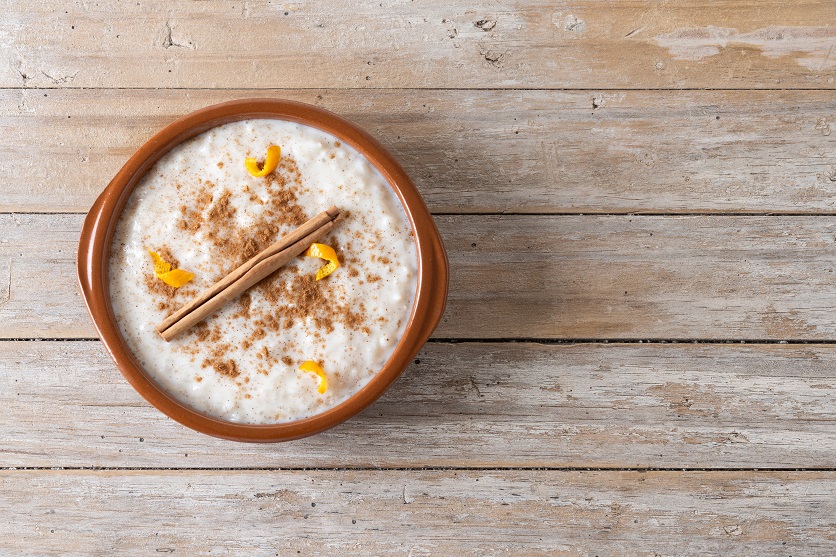
With the cold winds blowing and the threat of snow in its breeze, it’s time for a warming traditional sweet treat to soothe and uplift – rice pudding has always been one of those recipes. At this time of year it benefits from a touch of citrus brightness and fragrant spice. Of course, it is delicious without the spice and orange. But they add that lovely whisper that Christmas is just around the corner.
The Origins of Rice Pudding
Rice pudding likely originated in Asia, where rice cultivation began, with early versions made by boiling rice in water or milk. India has one of the oldest documented rice pudding traditions, kheer or payasam, mentioned in classical texts such as the Suśrutasaṃhitā (41-42), Nāṭyaśāstra, and Buddhist Pāli writings. These texts describe pāyasa, a milk‑grain dish used in daily life and rituals. They show a long tradition of milk‑grain preparations that evolved into the sweet, spiced dessert we know today, flavoured with ingredients like cardamom, saffron, and nuts which is why I have added cardamom in this recipe, a nod to that history.
Rice Pudding’s Route to Ireland
Rice was introduced to Europe through trade, particularly via the Arabs to Spain and Italy in the Middle Ages. By the 14th century, rice pudding recipes appeared in English cookery manuscripts such as the 1390 The Forme of Cury (see recipe V). They were mainly savoury pottages1 and considered a delicacy. Sweetened rice puddings don’t appear in recipes until the 15th century. One such recipe appears in the The Austin Manuscripts (c. 1440s), called ‘Whyte Worts‘ (v), using rice flour, milk, and honey. And yes, I needed ai to translate the medieval English, but it ends perfectly, “Serve it forth, it makes a good pottage“!
As rice and sugar were expensive imports, rice pudding would have been a dessert for wealthier households. It wasn’t until the early 20th century, when rice became more affordable and widely available in shops, that rice pudding moved beyond a luxury and became a familiar dessert in many Irish homes. It was likely still less common in poorer rural households, but for many families it had become a comforting choice for Sundays or special occasions.
Nowadays, you can buy creamed rice in tins everywhere, but nothing can come close to the flavour and creaminess of baking it yourself. And it just couldn’t be simpler to make!
Rice Pudding at Christmas
In Nordic countries, a special rice pudding is traditionally eaten at Christmas, often with a whole almond hidden inside – whoever finds it is said to have good luck for the year ahead. In Denmark, on Christmas Eve a rice porridge is often transformed into risalamande – a cold rice pudding with whipped cream and almonds. The versions vary – some baked, some simply cooked on the hob – but the core festive rice pudding tradition, especially with the hidden almond, is shared across the region.
One can’t help but wonder whether Santa Claus himself has ever tasted a creamy, baked rice pudding!
Choosing the Perfect Rice
Given the difficulty of finding suitable gluten-free pudding rice, I tried this recipe with long-grain rice first, but the texture was never quite right. For this recipe, I’ve used Arborio rice, a short-grain, starchy rice originally from the Po Valley in northern Italy. Its high starch content creates the naturally creamy texture that makes baked rice pudding so comforting, while the grains stay tender and separate. Arborio rice, named after a town in Piedmont, was selected as a cultivar2 by agronomist Domenico Marchetti (see p.75) in the mid-20th century. Traditionally used for risottos, I have discovered it works beautifully for puddings too, giving a perfectly soft, creamy baked pudding every time.
Ingredients (serves 3-4)
- 75g arborio rice (I use Gallo)
- 45g caster sugar
- 400ml full fat milk
- 100ml single cream
- 1/2 tsp vanilla extract
- 2-3 cardamom pods
- zest of 1 orange
- knob of butter
Method
- Preheat oven 150°C/ 140°C Fan, and grease an ovenproof dish with the butter.
- Place the rice in the dish and set aside.
- In a saucepan, gently warm the milk, cream, sugar, zest, cardamom, and vanilla until just steaming (not boiling). This helps infuse the flavour better, but you can skip this and just pop all ingredients into the dish with the rice.
- Pour the mixture over the rice in the dish and stir to mix together.
- Bake in oven for 1.5-2 hours until the rice is tender. In a fan oven it will be ready sooner than a conventional oven. Also, if doing in a fan oven, cover dish with tin foil for about 45 minutes of cooking and remove tin foil for the remaining time.
- Remove from oven and allow to rest for about ten minutes so it thickens.
Serving Suggestions
- A light dusting of cinnamon
- Some orange zest, segments and/or syrup
- Dollop of whipped cream or jam or both
- If you like a crunch, sprinkle some toasted, chopped nuts of choice
Drink pairings
- Chai tea
- Light roast coffee
- Glass of milk
- If preparing over Christmas, a sweet dessert wine such as Sauternes3, and
- Orange cordial (for children)
cover image (placeholder)
- A pottage was a thick, often savoury medieval stew made from grains, pulses, vegetables, or rice, widely eaten across Europe as an everyday dish. ↩︎
- The process of choosing plants with desirable traits (size, shape, starch content, yield, disease resistance, etc.) and propagating them so that the next generation inherits those traits. This is not the same as hybridisation or modern genetic modification. ↩︎
- Sauternes is a rich, sweet French dessert wine from Bordeaux, with notes of honey, apricot, citrus, and gentle spice. Its full-bodied, silky texture complements creamy desserts and enhances warm, fragrant flavours like orange and cardamom. ↩︎

Leave a comment