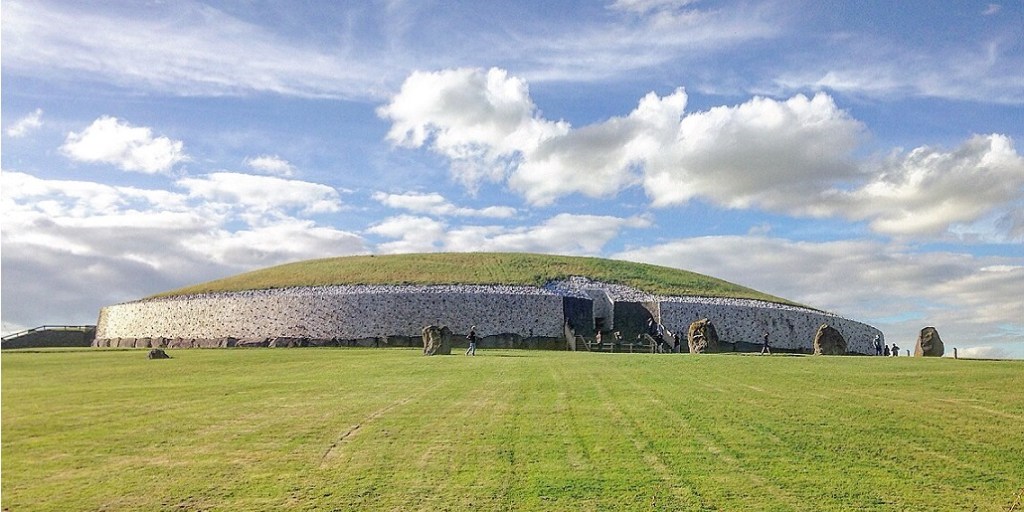
At this time of year during the winter solstice, Ireland offers stunning views of sunlight streaming into the chamber of the passage tomb Newgrange in County Meath, one of the world’s most famous prehistoric monuments.
But what exactly is a solstice, and how did people in the past understand it? Across prehistory, communities carefully observed the Sun, Moon, and stars, building monuments, planning settlements, and crafting objects that recorded their celestial knowledge. This shows that generations of sky reading shaped daily life, ritual, and belief, long before written records existed.
Solstice
Solstices mark the turning points of the year, when the Sun appears to reach its northernmost or southernmost point on the horizon before reversing direction – a phenomenon caused by the tilt of the Earth’s axis.
In prehistoric Europe, recognising these moments helped people understand the cycle of seasons, time agricultural activities, and structure ritual life.
There are two solstices:
- Winter solstice (around 21st of December): the shortest day and longest night of the year. The Sun rises and sets at its furthest points south on the horizon.
- Summer solstice (around 21st of June): the longest day and shortest night of the year. The Sun rises and sets at its furthest points north on the horizon.
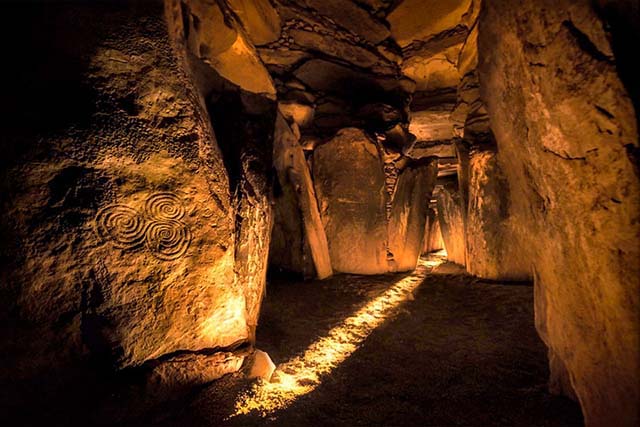
Between these two points, the Sun’s rising and setting positions move a little each day along the horizon. At the solstices, this movement appears to pause and reverse direction — which is why the word solstice comes from Latin solstitium, meaning “sun standing still”.
Reading the Sky in Prehistory
We cannot ask prehistoric people what they did, but we can look at what they built, the artefacts they made, and how they organised their lives – through the placement of settlements, seasonal patterns of farming and herding, burial practices, and the alignment of monuments with the Sun and Moon.
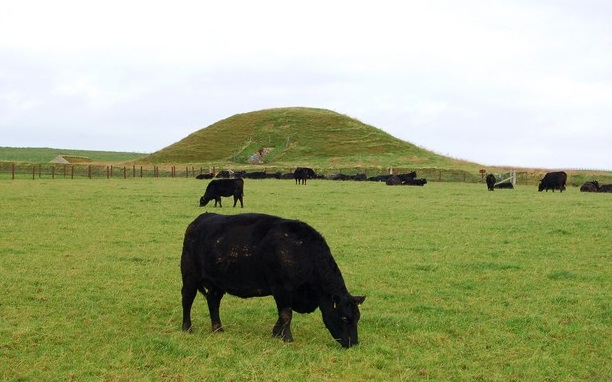
A Neolithic chambered tomb built around 2800 BC (image3)
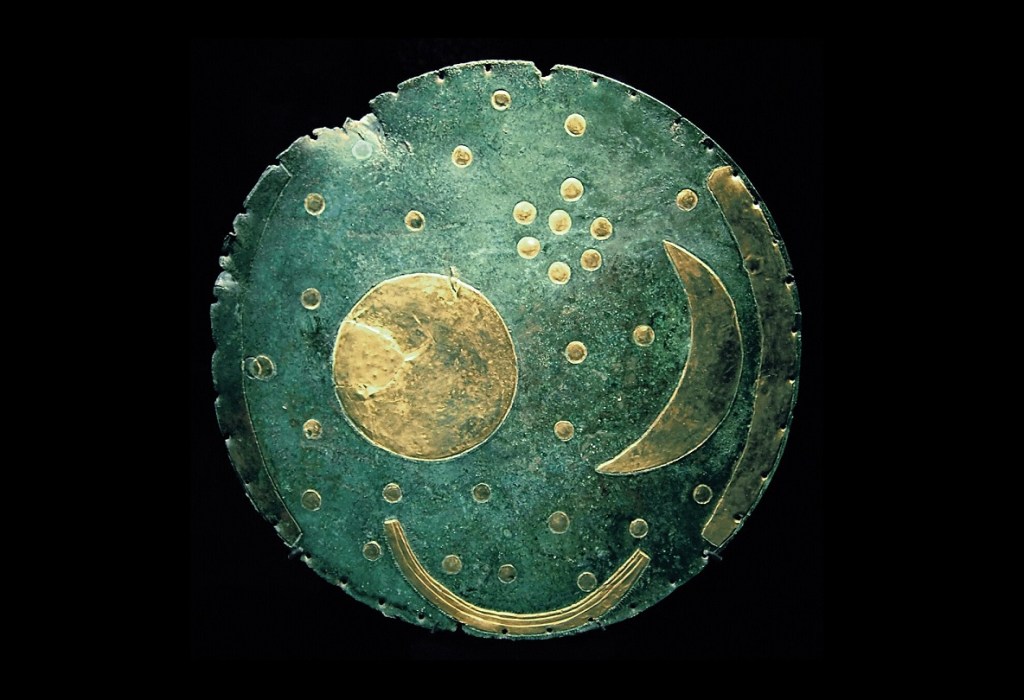
Across Europe, monuments such as Maeshowe on Orkney, Scotland; landscapes such as Brú na Bóinne (the “Palace of the River Boyne”) in Ireland; and objects like the Nebra Sky Disc (cover image4) reflect careful observation of the sky.
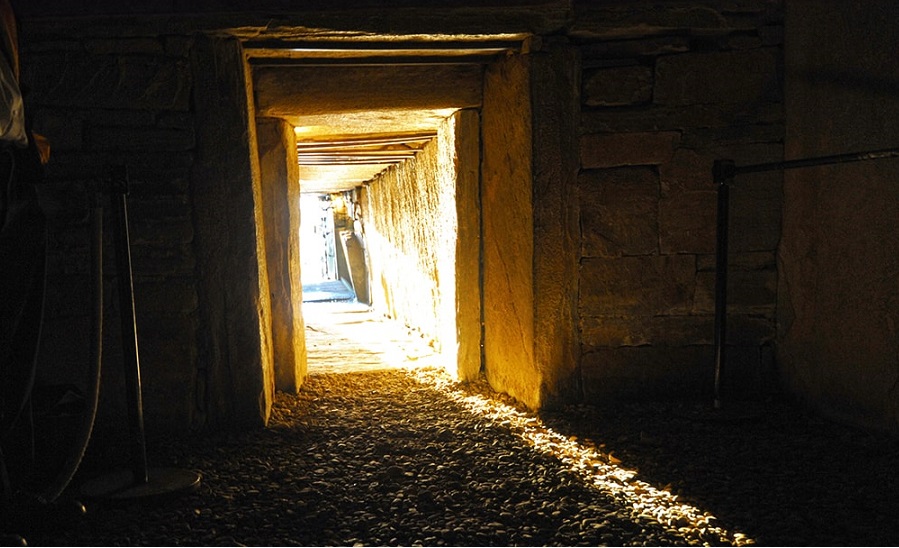
When the same solar and lunar reference points appear again and again, in different places and over long periods of time, coincidence becomes unlikely. Taken together, the evidence – from architecture to artefacts – is cumulative, cross-regional, and tells a coherent story, making sky reading the simplest and most convincing explanation.
Our earliest evidence for sky-reading is in the Neolithic with it intensifying in the Bronze Age. Knowledge evidenced from the monuments and artefacts reflects accumulated observational knowledge passed down through generations.
Symbolic and ritual evidence becomes more prominent in the Bronze Age: solar symbols, gold objects associated with light, and cyclical imagery all suggest the sky was not only observed but conceptually central to belief systems.
The Nebra Sky Disc: Knowledge, Belief, and Ritual
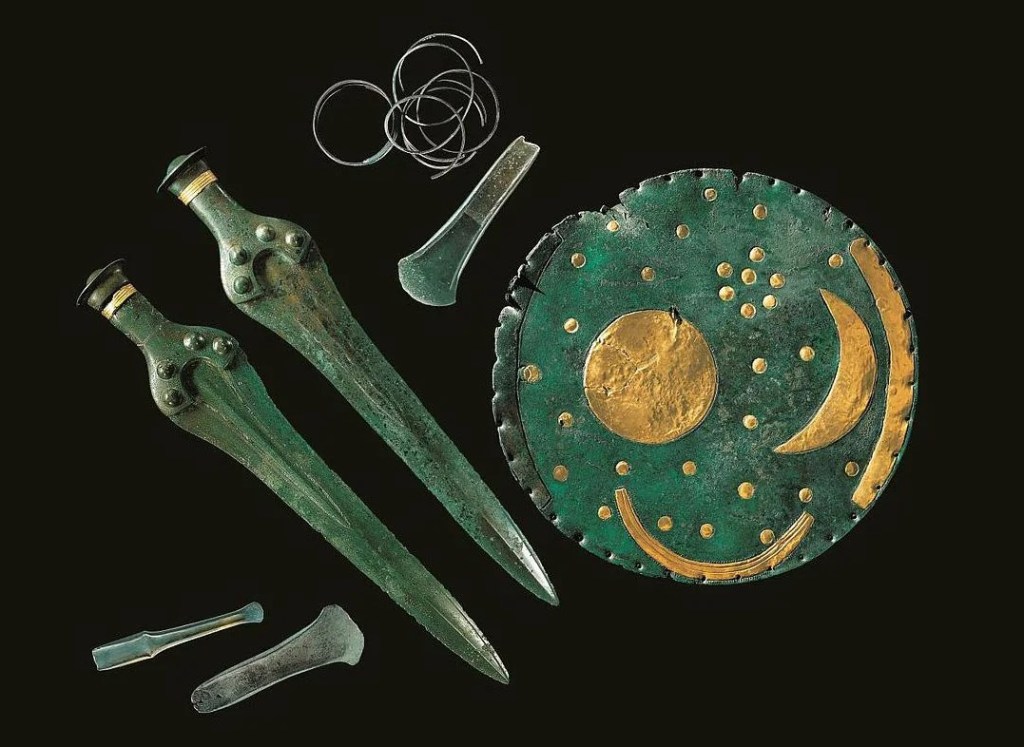
The Nebra Sky Disc is the earliest known portable artefact to capture the Sun, Moon, and stars together, offering a rare glimpse into the astronomical knowledge of people in prehistory.
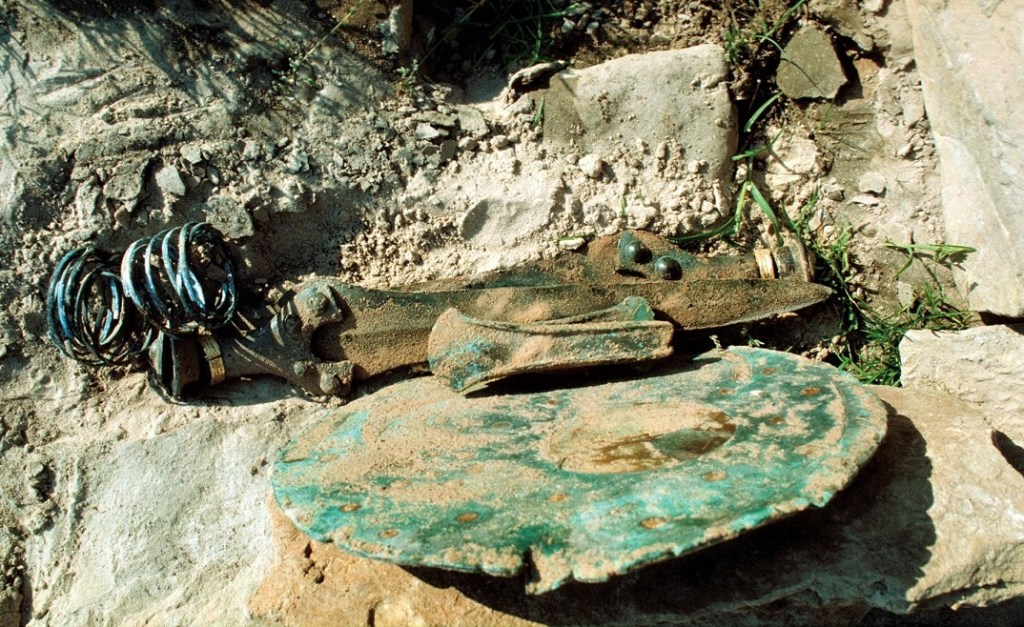
It was discovered as part of a hoard, while illegally metal detecting, in Germany in 1999. It is one of Europe’s most remarkable prehistoric artefacts. Dating to around 1600 BC, it is a bronze disc inlaid with gold symbols representing the Sun, Moon, and a cluster of stars – likely the Pleiades – along with two arcs thought to mark the horizon points of the summer and winter solstices.
What makes it extraordinary is that it appears to combine practical astronomical knowledge with symbolic and possibly religious meaning, showing that Bronze Age people were carefully observing the sky and tracking the seasons. Often described as Europe’s earliest “star map”, the disc offers a rare glimpse into how prehistoric societies understood and celebrated the heavens.
The find spot of the Nebra Hoard on Mittelberg hill is highly significant. Situated on a prominent high point in the Ziegelroda Forest near Nebra, the location suggests a ceremonial purpose rather than mere storage. From this vantage, the surrounding landscape and horizon could have been integrated with the disc’s astronomical features, such as the solstice arcs, linking celestial observation with the terrain. The hilltop also situates the hoard within a region rich in Bronze Age activity, including burial mounds and settlements, highlighting its role in broader social and ritual networks. Its placement likely reflects a combination of ritual, symbolic, and practical considerations, underscoring the Sky Disc’s significance as both a ceremonial and socially important object.
The site is now interpreted for the public with installations nearby, including the “eye of the sky” disc and an observation tower (see image below), which indicate the general location of the hoard and illustrate the hill’s horizon alignments. These markers allow visitors to appreciate the landscape context and ceremonial significance of the hoard.
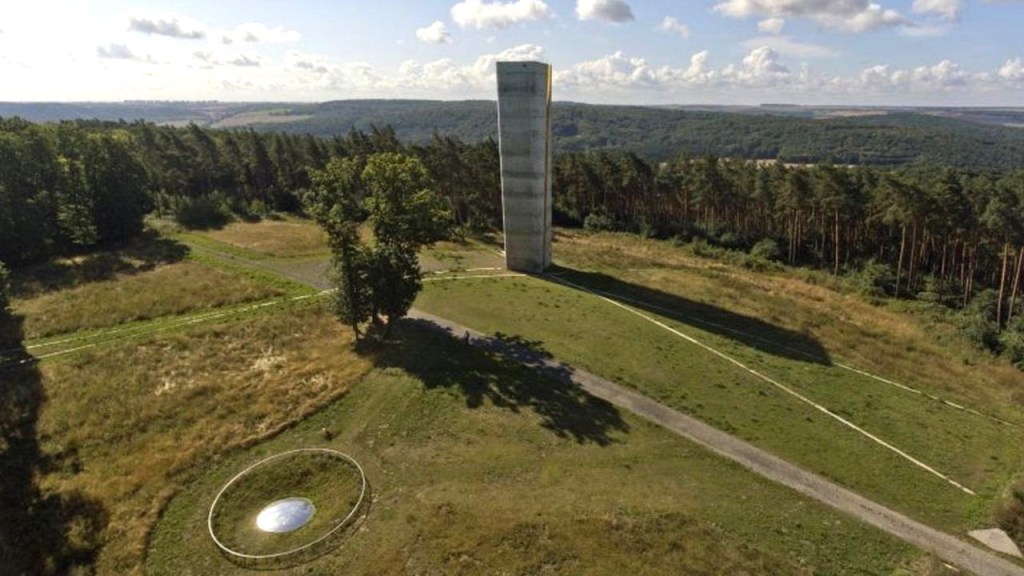
The Nebra Sky Disc reminds us that prehistoric people were not only keen observers of the sky but also thinkers and storytellers, weaving together knowledge, ritual, and symbolism in objects and monuments. From the aligned passage tombs of Neolithic Ireland to the carefully crafted gold inlays on a Bronze Age disc, the evidence shows a deep understanding of the Sun, Moon, and stars – and their importance in marking time, guiding agricultural life, and structuring ceremony.
These ancient sky-watchers left a legacy that connects us across millennia, revealing that the desire to read, measure, and make meaning of the heavens, is older than the world’s monumental landscapes themselves.
- Image: A front view of the Newgrange monument by Tjp finn, licensed under Creative Commons Attribution‑ShareAlike 4.0 International (CC BY‑SA 4.0). Source: Wikimedia Commons ↩︎
- Image: Winter Solstice Sunrise — Newgrange, Valley of the River Boyne (Ireland) by Ron Cogswell, licensed under CC BY‑SA 2.0, via Flickr ↩︎
- Image: Maeshowe by John Allan, licensed under Creative Commons Attribution‑ShareAlike 2.0 (CC BY‑SA 2.0), via Wikimedia Commons. ↩︎
- Image: Nebra Sky Disk” by Frank Vincentz, photographed 23 April 2022, public domain (faithful photographic reproduction of a public domain work of art). Source: Wikimedia Commons, File:Nebra disc 1.jpg (licensed as public domain) ↩︎
- Image: The Nebra Hoard. © State Office for Heritage Management and Archaeology Saxony‑Anhalt, Juraj Lipták ↩︎
- Image: Der Mittelberg mit Turm und Fundort der Himmelsscheibe — Arche Nebra / H.‑J. Steglich, © Arche Nebra (via Deutschlandfunk Kultur) ↩︎


Leave a comment