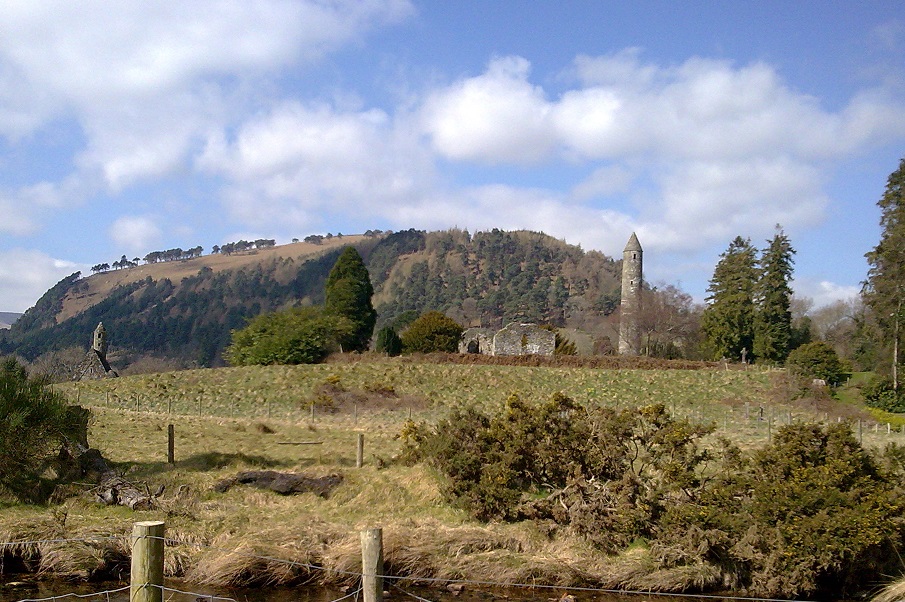
“Look! Rapunzel’s tower!”
This was a comment I heard a little girl excitedly tell her parents in Glendalough car park. She was pointing to the round tower behind the trees with utter glee in her face. Her reaction captures something essential about these structures: their height, their drama, and their ability to invite story.
Ireland’s round towers are among the most distinctive features of the early medieval landscape, yet their origins and functions remain only partly understood. Built over a period of roughly three centuries, they have been the subject of sustained academic debate, with interpretations evolving as archaeological, architectural, and historical evidence has been reassessed.
Dating the Towers
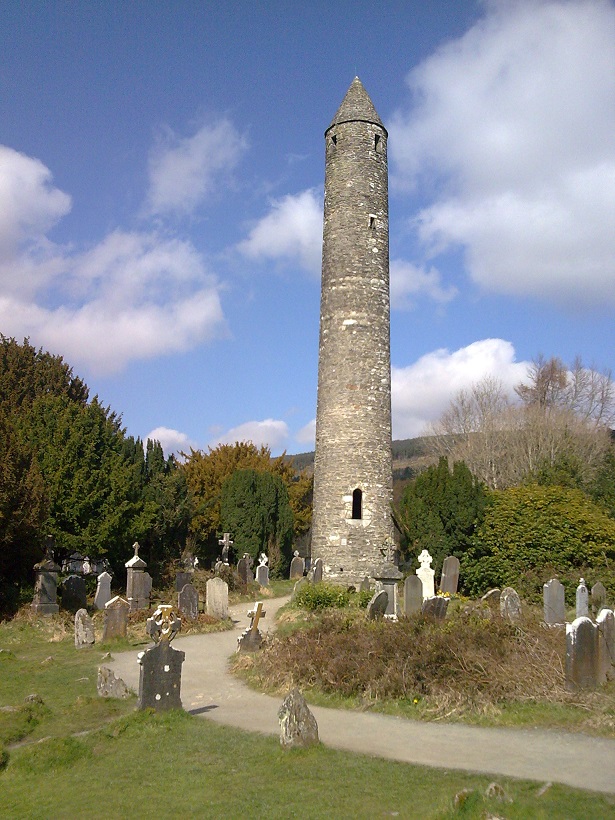
The earliest reference to a cloigtheach (bell-house) appears in the annals in AD 950, when the tower of Slane was burned. The final recorded construction dates to 1238, at Annaghdown in Co. Galway. This long span suggests that round towers were not static in purpose: their roles may have shifted over time, and their use may not always have aligned with the original intentions of those who commissioned them.
Dating the towers precisely is difficult. Archaeological excavation has produced little firm construction evidence, partly because towers were often reused as burial places. Art-historical dating has therefore played a significant role. Many towers appear to belong to the twelfth century, based on features such as ashlar masonry and Romanesque doorways, though some – such as Devenish in Co. Fermanagh – may represent later developments. It is also possible that earlier timber or stone predecessors existed, just as wooden churches predated stone churches in Ireland.
Origins and Influences
Debate about their origins centres on whether round towers were an indigenous Irish innovation or inspired by structures elsewhere in Europe. Most scholars agree that external influence played a role, though opinions differ on the source. Brian Lalor argues that building to such heights was not part of earlier Irish architectural tradition and suggests that Irish towers adapted European bell-tower models, particularly those of the Rhineland. Roger Stalley points to parallels with circular structures in Ravenna and later Carolingian influences. Tadhg O’Keeffe, however, sees the towers as fundamentally Irish in form, with distant European connections rooted not in contemporary bell-towers but in architectural traditions associated with the Holy Sepulchre in Jerusalem.
The remarkable uniformity of Irish round towers has led some scholars to propose the existence of an exemplar prototype, with Armagh often suggested. Many tower sites have associations to St. Patrick, and O’Keeffe argues that decisions about which ecclesiastical centres received towers may reflect long-standing hierarchies within Irish Christianity.
Bells and Daily Life
The most widely accepted practical function of round towers is as bell-houses. In the early medieval world, bells structured daily life: they summoned people to prayer, marked time, and ordered religious routine. As ecclesiastical settlements grew, increasing background noise may have reduced the bell’s reach, making height advantageous. The visual presence of a tall tower would also have reinforced authority and order.
The aistróir, or bell-ringer, is described in twelfth-century legal sources, which distinguish between the prestige of ringing a tower bell and the humility of ringing a hand-bell. Over seventy early Irish hand-bells survive, typically small, iron constructions producing a dull, resonant sound – perhaps reflected in the word clog (the modern Irish word for ‘clock’).
Some bells were coated in molten bronze to deepen their tone. The bell of Bangor Abbey, Co. Down is a good example, measuring 14 inches in height and about a third of an inch thick. It dates to the 9th century, has an incised fret border, and weighs about 9.25kg. Whether larger bells were suspended at the tops of towers remains uncertain. Bells may also have been rung using ropes within the tower shaft, and earlier bells may have been recast as technology advanced.
Monument, Ritual, and Power
While bell use appears central, most scholars accept that round towers were polyfunctional. Their scale exceeds what would have been strictly necessary for sound alone, leading many to argue that they were also intended as monuments. Christiaan Corlett describes them as monumental ecclesiastical architecture, designed to express the prestige of a church. O’Keeffe cautions against reducing them to mere “status symbols”, but accepts that status would inevitably have been communicated through their presence.
Seen across the landscape, round towers acted as visual and audible landmarks, particularly for pilgrims. They were focal points of ecclesiastical settlements, marking spiritual territory and reinforcing connections between church, kingship, and patronage. Some scholars suggest that towers contained chapels or functioned as processional buildings, with liturgical activity taking place on upper storeys. Royal patrons may have viewed them as an effective way to embed themselves within church ritual and space.
Security and Storage
Round towers have also been associated with security, as lookouts, refuges, or treasuries. Modern scholarship largely rejects the idea that they were purpose-built defensive structures. Their narrow windows limit visibility, and their internal wooden floors made them dangerously vulnerable to fire. The annals record several instances of towers being burned with people sheltering inside, often with fatal results. At best, they may have offered temporary refuge.
Their use as treasuries is more plausible. Precious objects such as bells, books, and relics are frequently mentioned in accounts of tower burnings. Towers may have provided secure and elevated spaces from which valuable items could be protected or displayed to pilgrims.
Meaning Across Time
Taken together, the evidence suggests that round towers were complex structures with layered meanings. From the 10th to 12th centuries, they functioned as bell-houses, landmarks, ritual spaces, repositories, and symbols of authority. Religion and power were inseparable in early medieval Ireland, and round towers stand as enduring expressions of order, belief, and presence – continuing to shape how the Irish landscape is experienced today.
County Kildare’s Round Towers
There are six round towers in Co. Kildare, none of which have their original conical caps. The round tower images below are ordered north to south:
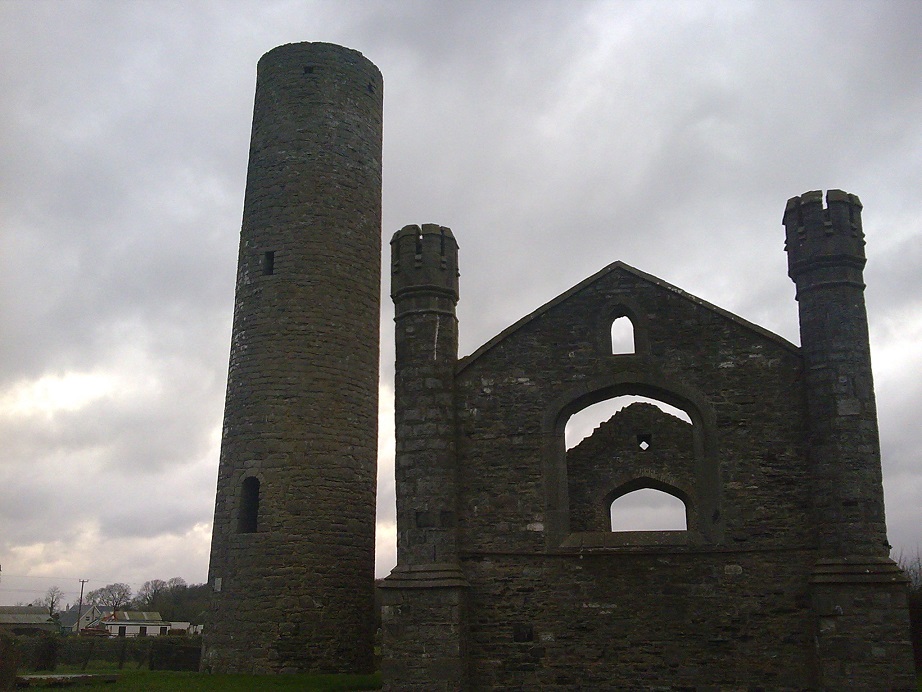
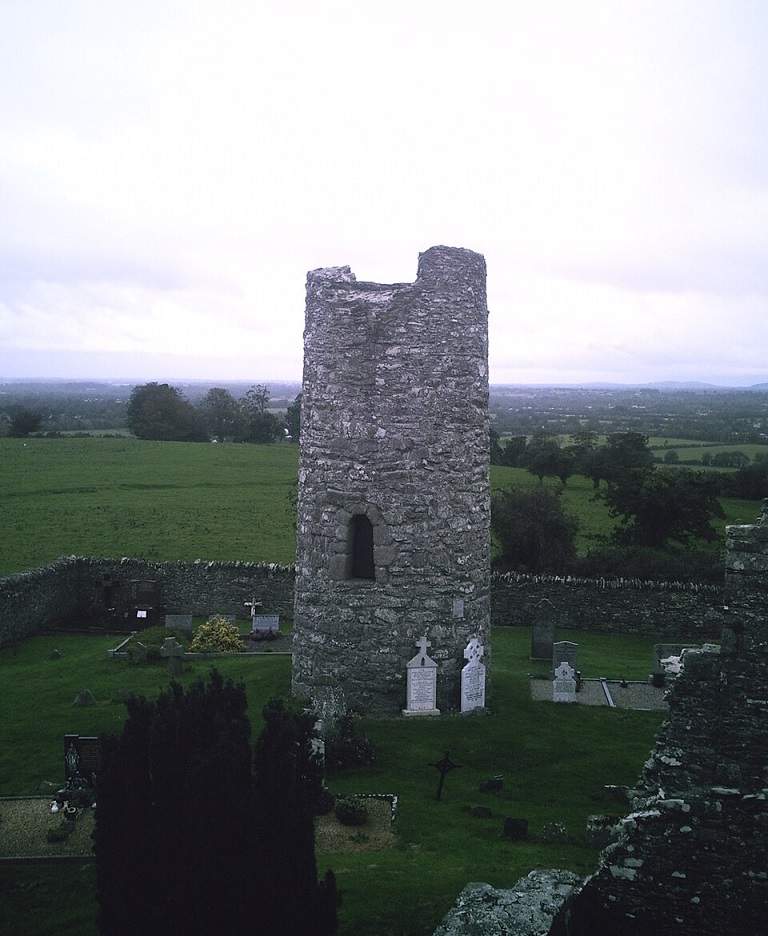
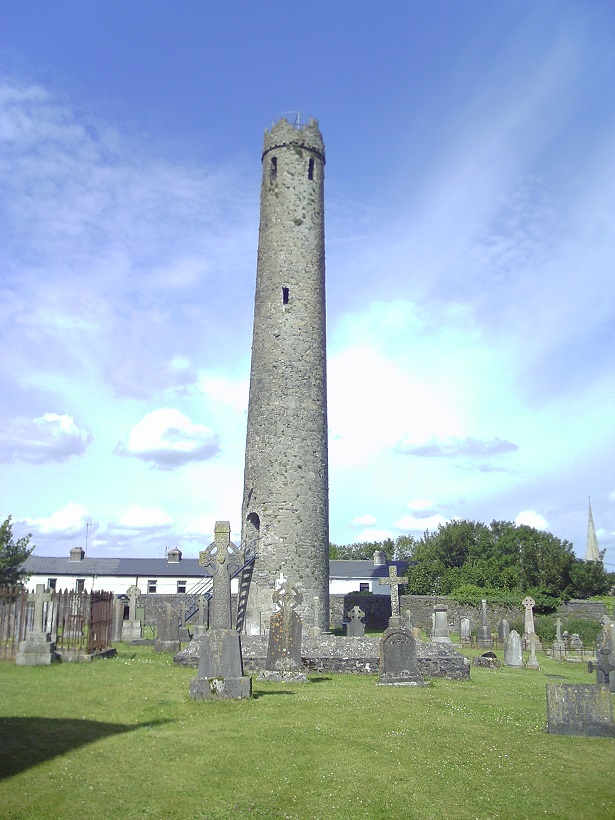
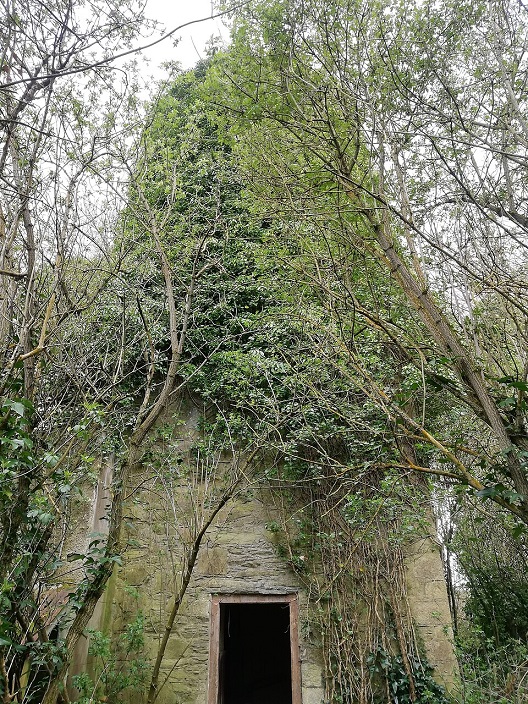
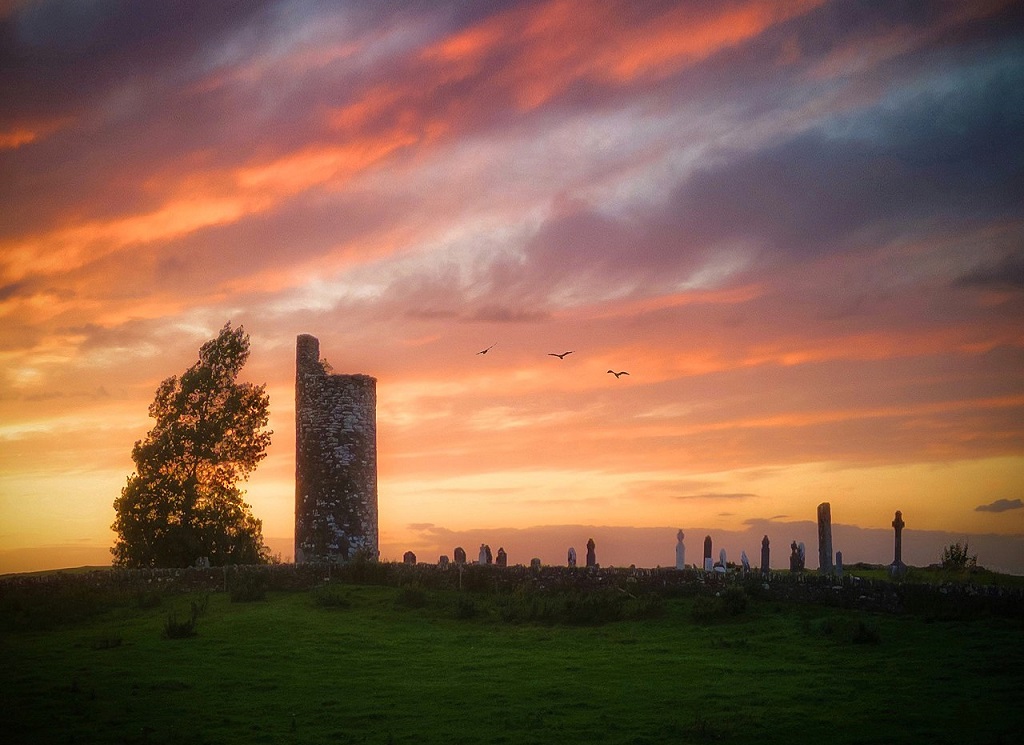
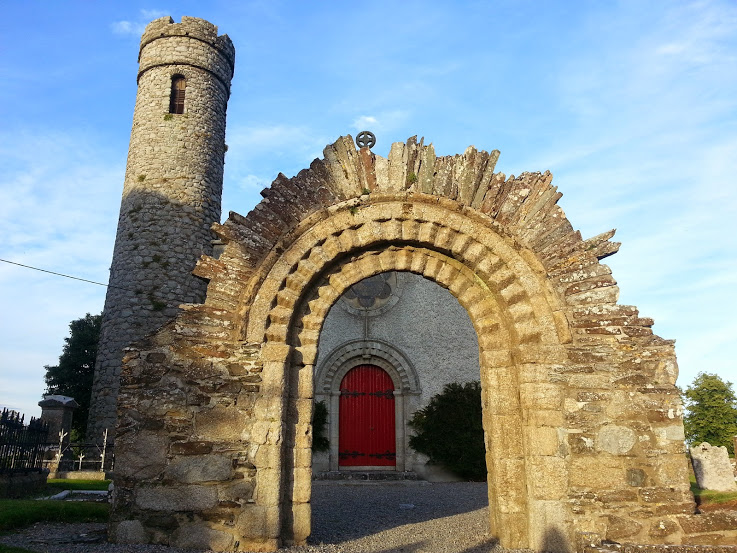
- Image: Oughterard Irish Round Tower, County Kildare”. Photo by GothmogLord, licensed under Creative Commons Attribution‑ShareAlike 3.0 Unported (CC BY‑SA 3.0). ↩︎
- Crenellated: from the Latin crenella, meaning “a little notch or scallop.” Refers to the notched pattern of battlements at the top of a wall or tower. Crenellations were widespread as a defensive feature on castles, city walls, and fortified towers during the medieval period. From the 16th century onward, they were sometimes used decoratively rather than defensively. ↩︎
- Image: “Killashee Round Tower”. Photo by Sheila1988, licensed under Creative Commons Attribution‑ShareAlike 4.0 International (CC BY‑SA 4.0). ↩︎
- Image: Old Kilcullen – Old Kilcullen Church”. Photo by Markiemcg1, licensed under Creative Commons Attribution-ShareAlike 4.0 International (CC BY-SA 4.0): modified. ↩︎
- Image: Castledermot Round Tower with Original Church Door”. Photo by Or la freedom, licensed under Creative Commons Attribution‑ShareAlike 4.0 International (CC BY‑SA 4.0). ↩︎


Leave a comment