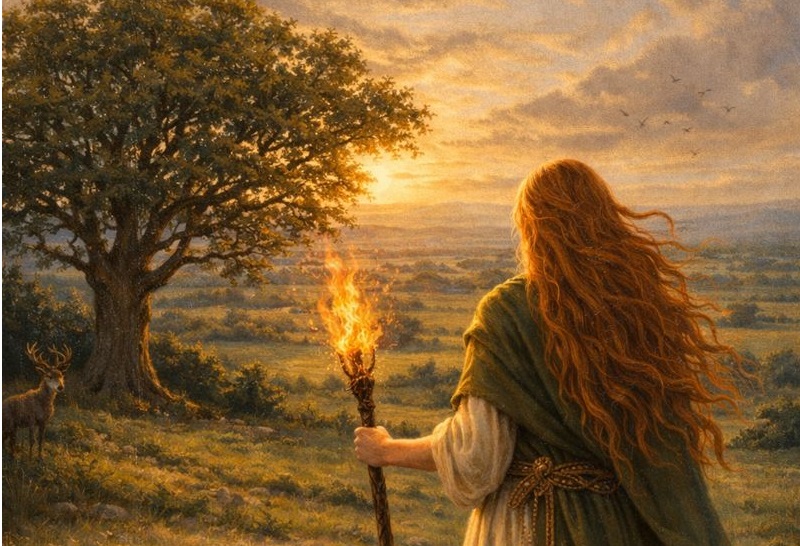
It’s St. Brigid’s Day – Imbolc, the start of spring. 🌱
St. Brigid’s Day, the 1st of February
Today St Brigid’s Day is marked as a mix of Christian and older seasonal and pagan traditions. Many people make St Brigid’s crosses from rushes, visit holy wells, or leave a Brat Bríde (a ribbon or cloth) outside overnight to receive Brigid’s blessing. It is also increasingly celebrated as a cultural and community festival, with talks, music, crafts, fire and light symbolism, and reflections on renewal, creativity and the return of growth after winter. In Ireland it is now a public holiday, often used to honour women, care, and the idea of new beginnings alongside the ancient marking of spring.
What was Imbolc?
The word Imbolc or Imbolg has an uncertain origin, but it is usually linked to milk and pregnancy. The most widely accepted explanation is that it comes from Old Irish i mbolg, meaning “in the belly,” a reference to pregnant sheep and the coming lambing season. This signalled the return of milk, fitting with Imbolc’s role as an early spring festival marking the turning of the year from winter towards spring. It fell around the 1st of February, and was one of the four quarters of the agricultural cycle (the others being Bealtaine, Lughnasa, and Samhain).
Imbolc was a liminal time, concerned with renewal, fertility, light and protection. Fires and candles were important, symbolising the strengthening sun. Homes and byres (cowsheds) were cleaned, and rituals were carried out to safeguard livestock, crops and people for the coming year.
Imbolc was associated with the pagan tripartite goddess Brigid, the daughter(s) of Boann and Dagda (one of the chief gods of the Tuatha Dé Danann1). She was a figure linked to fire, healing, poetry, craft and fertility. When Christianity spread, Brigid was absorbed or syncretised into the figure of St Brigid, and many of the older customs continued under a Christian framework.
In essence, Imbolc was about hope, preparation and the quiet but certain return of life in the natural world.
Food Traditions at Imbolc
Dishes
Imbolc was a time for celebratory meals that marked the end of winter and the beginning of spring. In some areas, St. Brigid’s Eve was celebrated almost like Christmas, with families preparing hearty meals and treats to honour the festival. Traditional dishes often centred on potatoes and dairy, reflecting the season’s first milking and the staple foods of rural Ireland.
Potatoes featured in dishes like boxty – pan-fried potato pancakes – and regional variants such as poundies, made by pressing or mashing potatoes.
Dairy also played a central role, with fresh milk, butter, and cheese forming the basis of many dishes.
Other foods included colcannon, dumplings, and rice pudding2, the latter suggesting access to special ingredients for a festive occasion.
Brigid’s Crosses
St. Brigid’s crosses, traditionally woven from rushes, were more than decorative; they symbolised protection and fertility. In some areas, food items like oats, corn, or potatoes were incorporated into the crosses or placed alongside them. These were later used as seed for the first sowing of the year, linking the tradition directly to agricultural cycles and food production.
Crosses were also believed to protect households and livestock, highlighting the intertwining of spiritual beliefs with practical needs in early Irish life. The use of both pagan and Christian practices, such as combining holy water with hen dung for crop protection, shows the layered history of these customs.
Biddy Boys and Brídeogs
The tradition of Biddy Boys and Brídeogs involved young people or men dressing up and going door to door, carrying an effigy of Brigid often made from a turnip or churn dash (a wooden crosspiece inside a traditional butter churn). While collecting food or donations for a communal celebration, participants reinforced social bonds and celebrated the season’s first harvest gifts.
Eggs and other local produce were sometimes collected, reflecting the practical and symbolic role of food in these festivities. Though this custom was fading by the 1930s, it illustrates how food and ritual combined in playful, community-focused ways.
Brigid, Miracles, and Religion
Stories of St. Brigid often highlight her miraculous provision of food, underlining the festival’s association with nourishment and abundance. Legends recount her feeding guests with seemingly insufficient supplies, blessing milk, butter, and bread, or leaving food at wells for the community. These tales blend Christian and pre-Christian elements, emphasising the spiritual significance of food during Imbolc.
Households engaged in rituals to ensure prosperity, using food both as an offering and as a protective charm, demonstrating the deep cultural importance of sustenance in early Irish celebrations of spring.
For more on the food traditions of Imbolc3
image: ai-created
- Tuatha Dé Danann: a supernatural race in Irish mythology, often described as gods or deities of pre-Christian Ireland. They were skilled in magic, arts, and crafts, and were associated with fertility, the land, and sovereignty. ↩︎
- For the origins of rice pudding, see the introductory section on Oak & Oolite‘s blog post: Winter Orange & Cardamom Baked Rice Pudding ↩︎
- The final section of this post is based on the findings in this article: Nic Philibín, C. & Mac Con Iomaire, M. 2021: ‘An exploratory study of food traditions associated with Imbolg (St. Brigid’s Day)‘ from The Irish Schools’ Folklore Collection, Folk Life, 59:2, 141-160. ↩︎

Leave a comment