What is a Standing Stone?
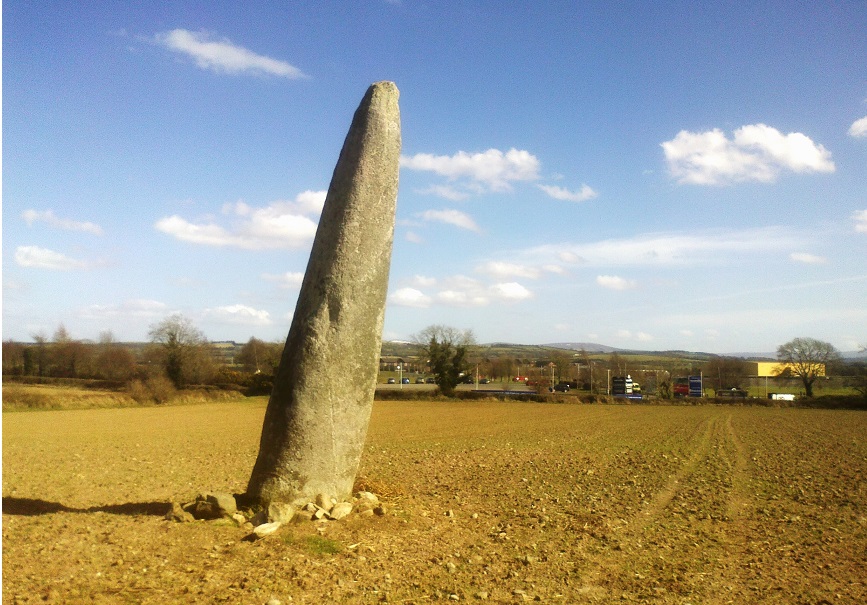
A standing stone, otherwise known as a long stone or menhir1 (gallán, dallán, líagán), is a single upright stone that has been deliberately placed into the ground. Standing stones are a type of megalithic monument2 often used for ritual, ceremonial, or funerary purposes. They vary in height and generally range from about half a metre up to about 6 metres, although a few can be taller as you will see below!
The basic concept of erecting a single upright stone for ritual, burial, or territorial purposes appears globally but the dense tradition of standing stones, stone rows, and stone circles, is mainly European (especially north-western Europe). They are quite widespread throughout Ireland and are not necessarily all of one period or purpose. Cork and Kerry have the greatest concentrations of standing stones with Cork recording over a thousand in the county. The high concentration in these counties likely reflects a combination of factors – available stone, strong prehistoric activity, and possibly, that there was a better survival of monuments in the landscape.
Most standing stones date to c. 2500–1500 BC – from the Chalcolithic period (Copper Age) to the Bronze Age, while others were reused later. A small number were later inscribed with Ogham3 or crosses during the early medieval period (as you will see below). The National Monuments Service (NMS) refers to them dating from the Bronze and Iron Ages (c. 2400 BC – AD 500), with some associated with early medieval ecclesiastical and burial contexts (c. 5th–12th centuries)4.
They are frequently found in locations of ritual, symbolic, or territorial importance and functioned as prehistoric burial markers, commemorative monuments, and indicators of routeways or boundaries.
The Standing Stones of County Kildare
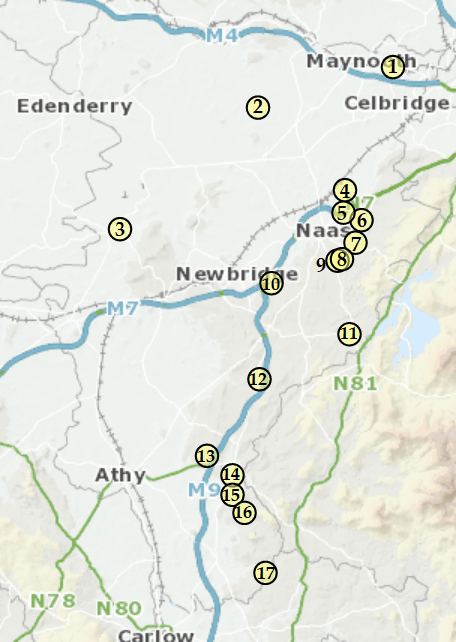
Given that around 4,000 years have passed, it is likely that there were originally more, but the NMS has currently recorded 17 standing stones in County Kildare. These are listed below with information and map gained from archaeology.ie:
- Kilmacredock Lower (KD006-010): recorded in 1972 as a limestone boulder lying in a field with a length of 1.3m. There was no trace of the stone in 1985.
- Dunmurraghill (KD009-013): Unknown stone. Described by the landowner in 2011 as, “a low standing stone” which was removed by his father who thought it was a scratching post. It has not been located.
- Rathangan (KD017-049): Granite stone with a height of 1.4m.
- Palmerstown Demesne (KD019-065): Of limestone measuring 1.46m in height with an almost square base.
- Maudlings (KD019-059): Granite stone with a height of 1.62m. A small perforation pierces the top of the almost square stone.
- Forenaghts Great (KD019-022002): Granite stone with a height of 5.3m. Found at the centre of an enclosure (KD019-022001) with a cist5 (KD019-022001) found immediately to its NW. Excavation of the cist also revealed that the standing stone was set in a rock-cut socket-hole in the natural bedrock.
- Newtown (KD019-041): Granite stone, 3.35m in height. The upper part has been roughly worked into the shape of a cross. A rounded-rectangular base before narrowing to an almost square shape above.
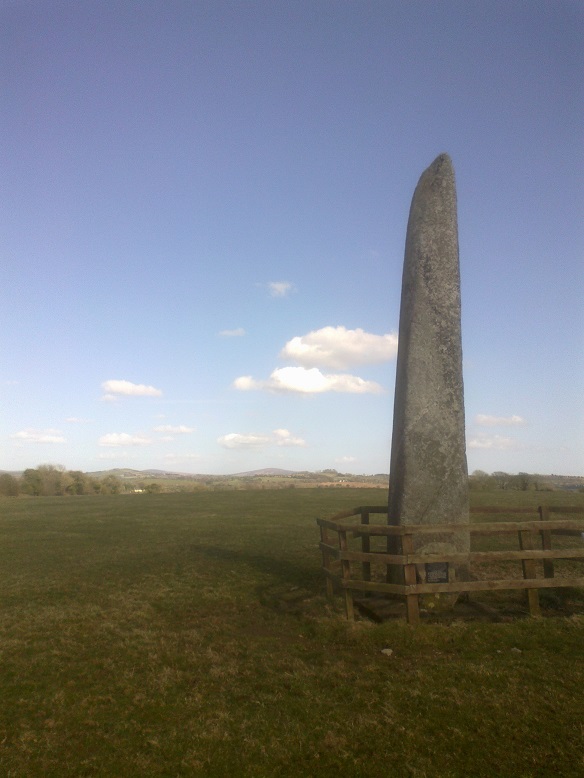
- Punchestown Great (KD024-009001): Granite stone, with a height of 7m it is the tallest standing stone in Ireland and the second tallest in the British Isles6. It weighs about 9 tonnes.
- Cradockstown West (KD024-007): Granite stone, 4.1m in height, and has a rectangular cross section.
- Greatconnell (KD023-015): Granite stone, 1.9m in height with a rectangular cross-section. The stone has been relocated twice in the area since 1979.
- Broadleas Commons (KG029-014001): Granite stone, recorded in 1839 as “having been thrown down”, lies on the ground measuring 4.1m in length.
- Kilgowan (KD032-012001): Granite stone with a height of 2.3m. There is a later cross incised on its SW face. Meagher (1936, 192) records that, “…100 years ago or more, Father Lawlor and Father Cummins lived in a garden at Kilgowan cross-roads…; and it was one of these men that cut the cross on the Long Stone”.
- Mullamast (KD036-017; KD036-017001): Granite stone with a height of 1.8m with a sub-rectangular cross section. It is not in its original location hence the two record numbers.
- Timolin (KD036-027001): Unknown stone. Fitzgerald (JKAS 1906, 464-465) records that a standing stone formerly stood near the village of Timolin, but that it had been removed, “many years ago”. A possible cist (KD036-027002) containing bones was, “discovered near its base”.
- Simonstown West (KD038-005): Granite stone, with a height of 2.45m and a sub-rectangular cross section.
- Sheriffhill (KD038-065): Unknown stone. Standing stone marked at this location by Peter Danaher while carrying out a survey of archaeological sites in Co. Kildare in 1955.
- Ballyraggan (KD040-040): Granite stone, with a height of c.1.5m. The 2016 record update states that it was removed some years ago.
Granite and the Sacred Landscape
Kildare is almost entirely underlain by limestone, except for in the south of the county from Castledermot southwards where granite7 is found. If you have visited the round tower at Castledermot you may have noticed that it is constructed from granite boulders. Based on the map above, many of the standing stones appear to align with the western edge of the Wicklow Mountains. Given that most of the stones are granite, it may suggest that the mountainous landscape, and possibly even a specific source, held some significance for the communities who erected them – whether the stone was sourced in south Kildare or east in the Wicklow Mountains.
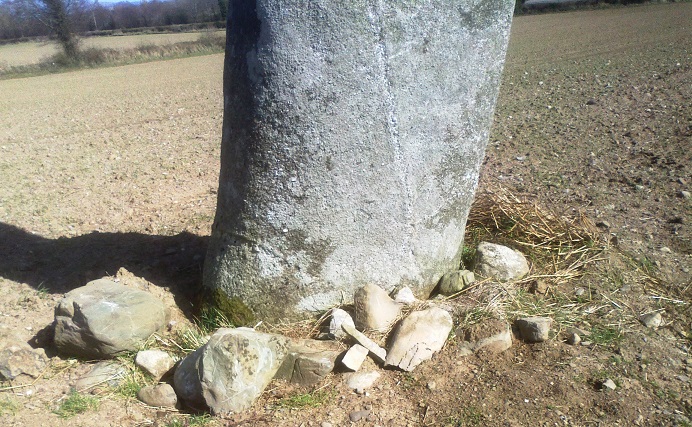
A number of years ago I undertook some research on the Punchestown Great and Cradockstown West standing stones. I noticed that they have visual similarities and so sought the expertise of geologist, Dr Richard Unitt of the School of Biological Earth and Environmental Sciences at University College Cork. According to Richard, the seams in both stones “look like thin aplitic or pegmatitic veins8; much of the granite could have similar textures and it is unlikely that the two blocks could be matched using this criteria; however, their size and shape possibly reflect jointing patterns in their source so it may be possible that the rock for the two standing stones were derived from the same place”.
If the stones were derived from the same source, this raises interesting questions about why and how prehistoric communities in Kildare selected and transported material for monument building. The movement of large granite blocks from Wicklow or south Kildare would have required considerable effort and organisation, suggesting that the erection of standing stones was a deliberate and socially significant act. It is also possible that particular outcrops or locations within the Wicklow granite may have held symbolic meaning, influencing where suitable stones were obtained. Choosing granite from specific outcrops or visible landscapes may also have carried meaning, linking the monument to particular places.
Upland or mountainous landscapes were often considered sacred or liminal (on the threshold or “between two worlds”), and may have been seen as places of transition – between the living and the dead, between human and divine, or between settled and wild landscapes. Erecting monuments like standing stones near or on mountains could possibly have marked these liminal zones, giving the monument spiritual, ritual, or symbolic power. The use of granite could have symbolically connected the standing stones to natural features seen as powerful or protective. Also, ethnographic analogies suggest that societies often assign symbolic value to the physical qualities of material, especially in monumental contexts. Granite, in addition to its aesthetic beauty, is durable and may well have signalled strength, endurance, or spiritual significance.
Metallurgy and a New Way of Thinking
The Copper Age in Ireland was a transitional period when the introduction of copper was no doubt an exciting new technology9 and was contemporaneous with stone ritual contexts. It is interesting to note that the two main sources for copper production during the Copper Age are in Ross Island, Co. Kerry and Mount Gabriel, Co. Cork – the two counties with the highest number of standing stones.
It is plausible to suggest that the introduction of copper and early metal technology may have influenced how prehistoric communities thought about and worked with stone, even if copper tools were not the primary means of extracting or shaping hard rocks like granite.
Standing Stones and Ancestral Memory
Many standing stones are associated with burial contexts. Archaeological surveys in Kildare show standing stones near prehistoric places of burial, implying a strong symbolic connection between upright stones and funerary practices. Their placement near burials highlights a dual role: commemorative and territorial, marking both the dead and the landscape as socially or ritually significant. To echo Gabriel Cooney, by placing and/or marking burials with these monuments, prehistoric communities were making their ancestors visible in the landscape10.
Megalithic monuments such as standing stones therefore provide an almost permanent reminder of their lives, both through the act of their construction and through their role as commemorative features within the landscape.
For more information on archaeological monuments see the NMS pdf guide: Irish Field Monuments.
Please note that many archaeological monuments are located on private land, so it is advisable to seek permission before visiting.
cover image: Cradockstown West standing stone viewing east.
- Menhir: from Breton – men (stone) and hir (long) ↩︎
- Megalithic monuments: large prehistoric stone structures or arrangements built without the use of mortar. The term comes from the Greek mega (large) and lithos (stone). They include standing stones, stone circles, stone rows, dolmens (portal tombs), and passage tombs. Found across Europe, western Asia, and parts of Africa, they mostly date from the Neolithic to the Bronze Age. ↩︎
- Ogham: the earliest form of writing in Ireland, used primarily between c. AD 400–700.
It consists of linear strokes or notches carved along the edge of a stone or piece of wood, representing letters. It was mainly used to inscribe personal names, memorials, or territorial markers. Most surviving examples are found on stones in early medieval burial or boundary contexts. ↩︎ - archaeology.ie ↩︎
- Cist: a small stone-built box containing human remains and often grave goods such as pottery. There a some Neolithic examples but most date to the Bronze Age and are frequently found beneath burial mounds, cairns, or near standing stones. ↩︎
- The Rudston Monolith: in Yorkshire is the tallest at 7.6m which may have originally stood at 8.5m in height with an estimated weight of 40 tonnes. ↩︎
- Type 1 Granite; Tullow Type 2 Equigranular Granite; Tullow Type 2 Microcline Porphyritic Granite. (GSI web-viewer) ↩︎
- Aplitic: A fine-grained variety of granite composed mainly of quartz and feldspar, often occurring as thin veins within larger granite bodies.
Pegmatitic: A coarse-grained granite texture with unusually large crystals, usually forming as veins or in the final stages of granite solidification. ↩︎ - O’Brien, W. 2012. ‘The Chalcolithic in Ireland: a chronological and cultural framework’ ↩︎
- Cooney, G. 2023. Death in Irish Prehistory. Dublin: Royal Irish Academy ↩︎

Leave a comment