Much of the popular legend surrounding Saint Patrick stems from two clerical writers in the 7th century – Tírechán and Muirchú. St. Patrick did exist but they wrote about him 2 centuries later. Their aim was to glorify his memory and advance the prestige of the church of Armagh, rather than to present a historically accurate biography of him.
So, what do we know about St. Patrick? Evidence for this is limited. He is mentioned in the annals (records of events, that began in the 7th century, or possibly, late 6th century) but 8th century scholars recreated annals for the 5th century, and pre-6th century was mostly guesswork. St. Patrick’s death was recorded twice in the annals – in AD 461 and AD 493, so there was disagreement about his chronology even in the 7th and 8th centuries. This has also led some to consider whether there may have been two different missionaries named Patrick.
Palladius1 was a 5th century Christian missionary, often considered the first bishop sent by Pope Celestine I to Ireland. The Annals of Ulster, a late medieval compilation, records his arrival as AD 431. There are no secure dates for St. Patrick. Some scholars have suggested that the stories of the two different missionaries, Palladius and Patrick, were later merged into one legendary figure.
The principle sources for historical St. Patrick are two short documents penned by himself which were copied and preserved in the early 9th century manuscript, the Book of Armagh2 (accessible online via Trinity College Dublin’s digital collections):
- Confessio of Saint Patrick (The Confession of Saint Patrick): folios 22r – 24b
- Epistola ad Coroticum (Letter to Coroticus): folios 24b–25v
Confessio of Saint Patrick
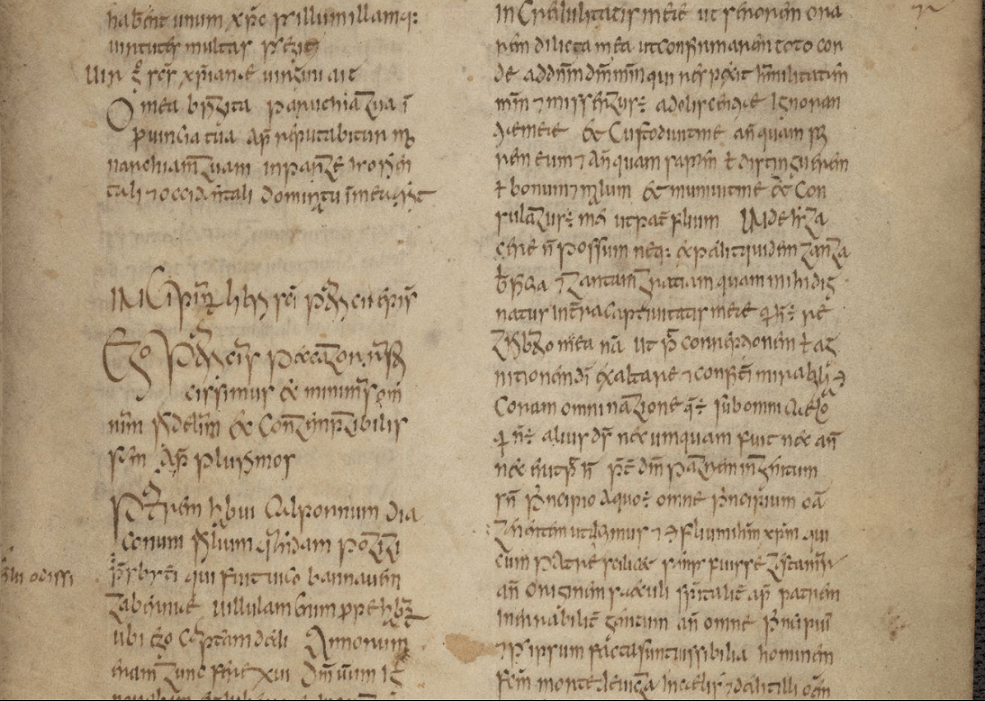
Scholars generally consider the Confessio to be earlier than the Epistola, dating it to the mid-5th century. Written in Latin and apparently by St. Patrick himself, it is a personal spiritual autobiography and confession of sins. It presents an early reflection on his life, captivity and mission. The text recounts St. Patrick’s birth, his kidnapping and enslavement in Ireland as a teenager, and his escape. It also describes his later return to Ireland as a missionary.
He presents himself as a humble and devout man, taken captive in Ireland as a teenager and initially ignorant of God. During his captivity, he experienced divine protection and spiritual awakening, which inspired a life of constant prayer, devotion, and obedience.
St. Patrick writes that his father and grandfather lived in a settlement called Bannavem Taburniae, and that there he was taken captive by Irish raiders. The exact location of this place is unknown and there has been a great deal of research and debate about where it might have been. Some scholars suggest it was on the west coast of Roman Britain, somewhere that could be raided by the Irish pirates, possibly in what is now north‑west England or south‑west Scotland. Others have proposed places in Wales, Cumbria, or near the Bristol Channel, based on similar Latin place‑names and archaeological context, but none is certain.
Despite his rustic background and lack of formal education (according to him), God elevated him to carry out a mission to convert the Irish, baptise thousands, and ordain clergy. Patrick faced repeated dangers, trials, and persecution, yet remained fearless and faithful, relying entirely on God’s guidance. He repeatedly emphasises that all his achievements were gifts from God, and he willingly devoted his life to the service and salvation of others.
Ultimately, St. Patrick is portrayed as humble, courageous, and selfless, deeply committed to spreading the Christian faith in Ireland.
“…before I was humbled I was like a stone lying in deep mire, and He that is mighty came and in His mercy raised me up and, indeed, lifted me high up and placed me on top of the wall. And from there I ought to shout out in gratitude to the Lord for his great favours in this world and for ever, that the mind of man cannot measure”. (§12)
Epistola ad Coroticum
The Epistola is a formal letter to Coroticus, a British Celtic warlord. It was written likely after St. Patrick had been active in Ireland for some time, once he had authority and experience to admonish others.
Coroticus was a British warlord or leader of a raiding party active during St. Patrick’s time in Ireland. He led a group of soldiers who raided Irish Christian communities, killed converts, and enslaved others. St. Patrick saw this as a grave sin against God and humanity, especially because the victims were newly converted Christians whom he had baptised and shepherded.
In response, St. Patrick wrote a strong letter condemning Coroticus, excommunicating him and his followers, and calling on them to repent, emphasising the spiritual consequences of their actions.
“He that offers sacrifice of the goods of the poor, is as one that sacrifices the son in the presence of his father. The riches…which he has gathered unjustly, shall be vomited up from his belly; the angel of death drags him away, by the fury of dragons he shall be tormented, the viper’s tongue shall kill him, unquenchable fire devours him.” (§8 – St. Patrick paraphrasing themes from the Old Testament)
Understanding Saint Patrick
These works are insufficient for even an outline biography, but they allow us to glean insights into St. Patrick’s character and who he was as a person.
From these texts, we see that St. Patrick was deeply devout and self-aware. In the Confessio, he repeatedly calls himself a “sinner” and “unlearned,” showing humility, yet he demonstrates steadfast courage and commitment in missionary work, willingly enduring hardship, exile, and danger to spread Christianity in Ireland.
He was compassionate and morally driven, especially toward the vulnerable. In the Epistola, his anger at Coroticus arises from outrage at injustice: the killing and enslavement of newly baptised Christians moves him profoundly. He writes passionately against violence, greed, and pride, showing a strong moral conscience and zeal for the protection of the innocent.
St. Patrick also demonstrates practical leadership: he organises clerics to intervene diplomatically, appeals for the ransom of captives, and encourages the faithful to avoid complicity with evil-doers.
Finally, he is resolutely focused on God’s will. Both writings emphasise that his actions are guided by divine calling rather than personal ambition. Even in grief, he frames suffering in a larger spiritual perspective, seeing eternal rewards for the faithful and divine justice for the wicked.
I would also like to think that the land (and people) of Ireland had a profound effect on him and shaped who he became as a person:
“...after I reached Ireland I used to pasture the flock each day and I used to pray many times a day…I used to stay out in the forests and on the mountain and I would wake up before daylight to pray in the snow, in icy coldness, in rain, and I used to feel neither ill nor any slothfulness, because, as I now see, the Spirit was burning in me at that time”. (§16 in Confessio)
The St. Patrick that we can glean from historical evidence seems to be an ideal person to celebrate every year, and with Tirechán and Muírchú’s hagiography4 of him, they succeeded in securing a tradition of his remembrance in Ireland and worldwide, for over thirteen centuries.

Happy Saint Patrick’s Day, everyone! ☘️
References:
- Saint Patrick’s Confessio and Epistola (see links to English translation above)
- Binchy, D. A. 1962. ‘Patrick and his biographers: ancient and modern’ in Studia Hibernica, 2, pp.7–173.
- Charles-Edwards, T.M. 1993. ‘Palladius, Prosper, and Leo the Great: mission and primatial authority’ in D.N. Dumville, K. Grabowski and P. Sims-Williams (eds.), Saint Patrick, AD 493–1993. Woodbridge: Boydell Press, pp. 1–12.
- O’Loughlin, T. 1999. Saint Patrick: The Man and His Works. London: Triangle.
- Thompson, E.A., 1985. Who Was Saint Patrick? Woodbridge: Boydell Press.
- Palladius had served as archdeacon to Germanus of Auxerre, bishop in Gaul (modern France). Prosper of Aquitaine provides the earliest and most reliable contemporary reference: in his Chronicle (written in the 430s), he states that in AD 431 Palladius was ordained by Pope Celestine I and sent “to the Irish believing in Christ” as their first bishop. This suggests that Christians already existed in Ireland at that time, and that Palladius’ mission was primarily to shepherd an existing community rather than to begin evangelisation. ↩︎
- The Book of Armagh is a composite manuscript including: the New Testament of the Bible, Patrick’s Confessio and Epistola, and biographies of Patrick by Tírechán and Muirchú. Each section was likely copied from different source manuscripts. ↩︎
- Image: Book of Armagh, MS 52, Trinity College Dublin Digital Collections. The main text of the manuscript is Latin but within the margins you can find Irish notes made by later scribes, as on this page. ↩︎
- Hagiography: a biography of a saint or ecclesiastical leader, often idealised or written to emphasise their holiness and moral virtues. ↩︎
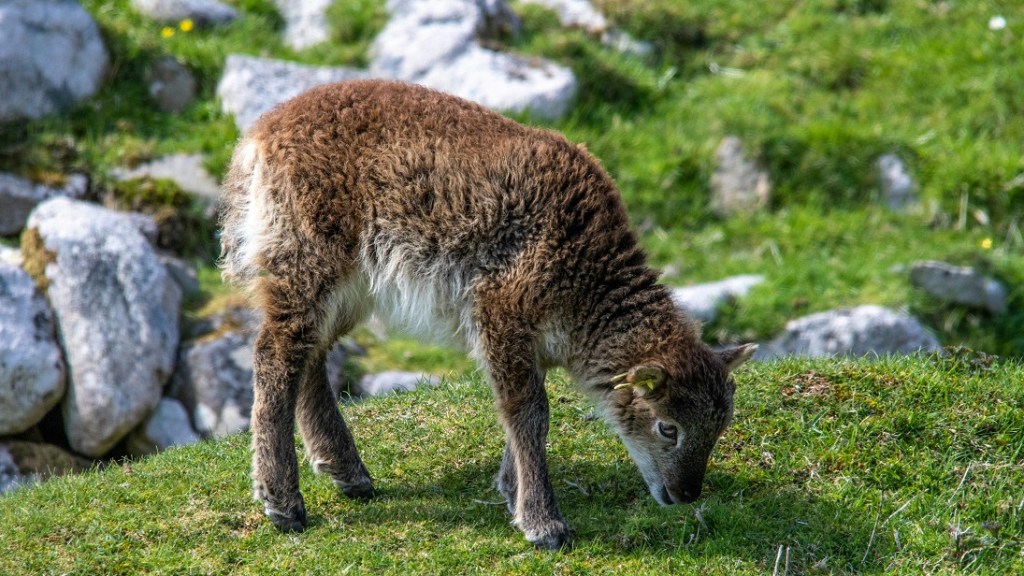
- Pictured is a Soay lamb of Saint Kilda in the Outer Hebrides, Scotland. This breed of sheep retains many features of the early sheep that would have populated Ireland (Kelly, F. 1997. Early Irish Farming. p 68). ↩︎

Leave a comment