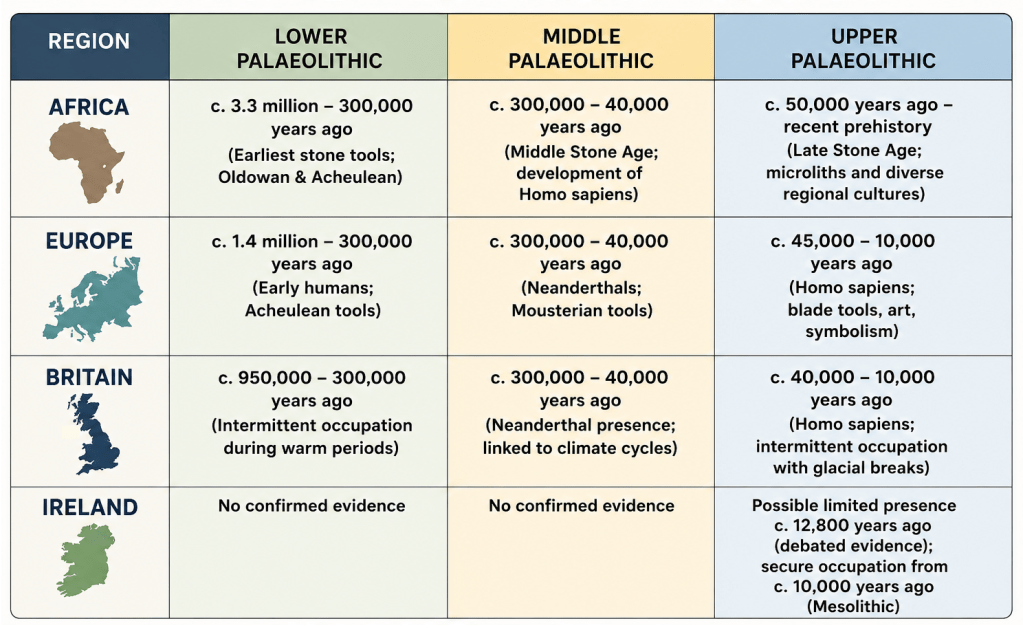
The Palaeolithic period, often called the Old Stone Age, is the earliest phase of human prehistory and spans from the first known use of stone tools by early human ancestors in Africa, roughly 3.3 million years ago to the beginning of the Holocene around 11,700 years ago.
It is characterised by small, mobile groups of hunter-gatherers who lived by following animal migrations, foraging for wild plants, and adapting closely to changing environments. Stone tools, such as simple flakes, hand-axes, and later more refined blades, are the main surviving evidence of this period, along with occasional traces of fire use, hunting activity, and rare but significant bone modifications.
The Palaeolithic is usually divided into Lower, Middle, and Upper phases, reflecting increasing technological and behavioural complexity, culminating in the Upper Palaeolithic, when modern humans expanded across much of Europe.
In Ireland, the Palaeolithic record is extremely sparse, so it remains uncertain whether there was human settlement at the time. This blog post discusses the evidence currently available and the possibility of human occupation of Ireland during the Palaeolithic.
Ireland in the Ice Age: an emerging habitable landscape
Earth is technically still in an ice age1, the fifth in the history of the planet. It is called the Quaternary Ice Age, and began about 2.6 million years ago. We are currently in an interglacial period called the Holocene, which began after the end of the Last Glacial Period (the Devensian glaciation)2, around 11,700 years ago.
During interglacials, most of the world’s land is ice-free, though large ice sheets remain in Greenland and Antarctica. These interglacial periods are warm phases that alternate with much colder glacial periods, which is why, despite our current relatively mild climate, the planet is still considered to be in an ice age.
The ice sheets covering Ireland and Britain began melting at the end of the Last Glacial Maximum3 from around 19,000 years ago onwards, but the process was gradual and varied across different regions. By around 15,000 to 14,000 years ago Ireland was largely ice-free, with only possible small localised remnants in upland areas. The retreat of the ice sheets reshaped Ireland, forming many of its lakes, influencing development of river stream systems, depositing fertile soils, and creating many of the valleys, plains, and other landscape features that define the island today. It was within this changing environment that humans would eventually begin to settle.
As vegetation gradually recolonised the exposed landscape, tundra-like conditions gave way to birch and pine woodland, followed by more complex mixed forests as the climate continued to warm and stabilise during the early Holocene.
Meltwater channels carved out new drainage patterns, while vast quantities of glacial sediment were reworked by wind, rivers, and seasonal flooding, helping to shape fertile lowland soils and the patchwork of wetlands, eskers, and drumlin fields still visible today. These shifting environments created both opportunities and constraints for early human groups, who entered Ireland as hunter-gatherers adapting to a landscape that was still in transition rather than fully stabilised.
Was there a Palaeolithic presence in Ireland?
In short, there is no evidence for sustained settlement during the Palaeolithic in Ireland. If we take the evidence currently available we can say yes, there was most likely occasional presence.
The question of whether humans lived in Ireland during the Palaeolithic period remains one of the most debated topics in Irish archaeology. For much of the 20th century, the prevailing view was: there was no secure evidence for human occupation of Ireland before the Mesolithic period, beginning around 8000 BC4. That position was shaped by absence of evidence – ambiguous artefacts, no clear sites, and no stratified finds. However, as Carl Sagan5 would note, absence of evidence is not evidence of absence.
In recent years, the debate has shifted slightly due to more refined scientific analysis of cave faunal material from the Alice and Gwendolyn cave in County Clare.
Early claims for a Palaeolithic Ireland
In the late 19th and the early 20th centuries, archaeology was still a developing discipline in Ireland, and interpretations of stone tools often lacked the stratigraphic and dating frameworks available today.
In 1883, William Knowles published a paper on stone tools from Larne, Co. Antrim that he believed were Palaeolithic in date. Later research has since shown that these tools actually belonged to the Mesolithic period.
In 1927, J.P.T. Burchall published claims in Nature reporting possible Palaeolithic artefacts from County Sligo. He suggested evidence for early human activity at Ballyconnell (two artefacts), a cave on Coney Island (tools found on the beach) and Rosses Point (over 100 artefacts). At that time, his work was supported by J. Reid Moir, who was also arguing for a Palaeolithic presence in Britain.
However, these claims were later questioned. The Ballyconnell finds were thought to be naturally broken by glacial action rather than made by humans. The Coney Island material was linked to later coastal processes, and doubts were raised about whether Rosses Point artefacts were genuinely human-made. By 1930, most researchers agreed that the evidence could not be accepted as Palaeolithic without clearer geological context (Woodman, 1998, 566).
Antrim archaeologist Peter Woodman re-examined the Rosses Point material. Of 32 pieces, 21 were confirmed as human-made, but there is still no secure evidence to date them to the Palaeolithic. As a result, their age remains uncertain.
A similar case comes from Kilgreany Cave in County Waterford. A crouched burial found there in 1928 was first thought to be Magdalenian6 because it was found alongside bones of Ice Age animals. However, later excavations in 1934 showed that the cave layers had been disturbed with domesticated cattle bones mixed in with extinct species (Dowd, 2002, 87). This led Hallam L. Movius to reclassify the burial as likely Neolithic, a view later confirmed by radiocarbon dating in 1962.
Alice and Gwendoline Cave: the first secure evidence for Palaeolithic human presence in Ireland?
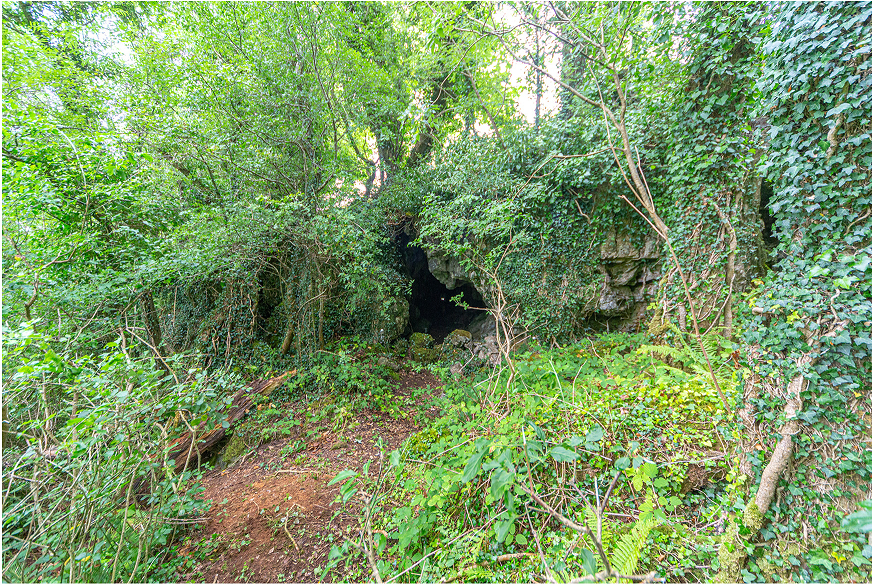
In 2016, Marion Dowd and Ruth Carden presented the first secure evidence for a Late Upper Palaeolithic human presence in Ireland. Their study focused on a brown bear patella (kneecap) recovered from Alice and Gwendoline Cave in Edenvale, County Clare, about 4km southwest of Ennis.
Alice and Gwendoline Cave was originally known as Bull Paddock Cave and renamed after Alice Jane and Gwendoline Clare Stacpoole, daughters of the family living at Edenvale House during the 1902 excavations.
The original excavation was undertaken in 1902 and recovered around 10,000–15,000 bone fragments, but interpretation was limited by early excavation methods, disturbed stratigraphy, and poor chronological control.
In 2011, osteoarchaeologist Dr Ruth Carden re-analysed bones from the Alice and Gwendoline Cave assemblage while working through archived cave faunal material in storage at the National Museum of Ireland. During this review, she identified cut marks on a brown bear bone, suggesting human butchery. This prompted collaboration with Dr Marion Dowd, who proposed radiocarbon dating the bone to test its age. Two independent radiocarbon dates place the bone at approximately 12,810–12,590 cal. BP (calibrated years before present), within the Younger Dryas period (a climate event of the late Pleistocene that happened immediately before the Holocene)7.
The bone shows clear cutmarks consistent with human butchery, confirmed by specialist analysis, indicating deliberate processing of the carcass. This result pushes back the earliest known evidence of human presence in Ireland by around 2,500 years earlier than the Mesolithic site at Mount Sandel. Dowd and Carden argue that this represents genuine human activity in Ireland during the Final Palaeolithic, although it remains a single, isolated piece of evidence rather than proof of sustained or widespread settlement.
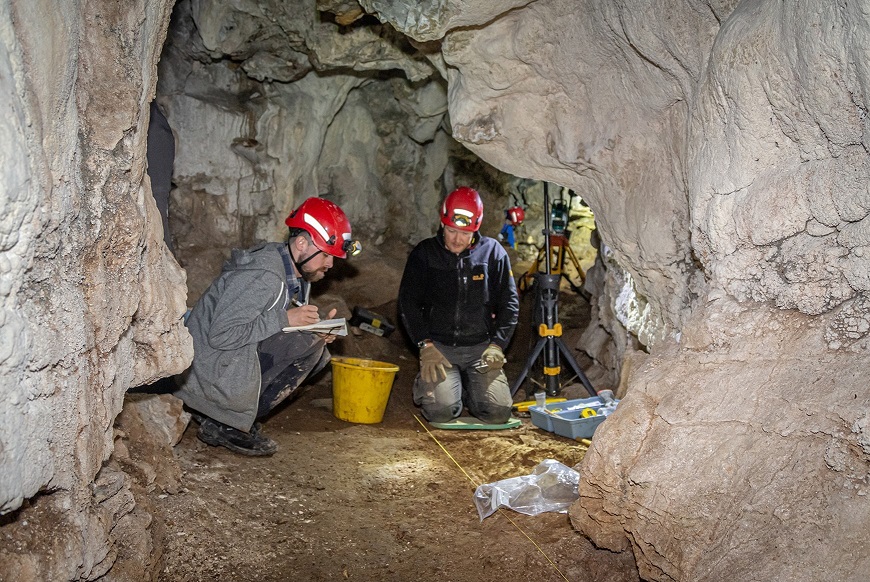
New excavations in 2019–2020, combined with improved radiocarbon dating and sediment lipid analysis, have clarified the site’s formation history and environmental context. The results show that the cave deposits, such as the bear bone, were largely washed in from outside the cave through fissures and openings, rather than accumulating through continuous occupation. This means that the cave is a secondary deposit site, and not a primary activity site. The cave evidence can point to human presence at unknown primary locations in the wider landscape, such as butchery spots, habitation areas, etc. But those original sites may never be found, having been destroyed by later erosion, glacial or post-glacial processes, or simply not preserved in a way that survives archaeologically.
The Pleistocene group (c. 13,100–9,400 cal. BP) is dominated by Ice Age fauna including brown bear, reindeer, giant deer, Arctic lemming, and large mammal fragments. Dates cluster around the Younger Dryas and immediate post-Younger Dryas, indicating repeated phases of deposition during the late glacial period.
The Holocene group (c. 11,600–1,300 cal. BP) includes brown bear, goose, human, and other species. Early Holocene material includes a human clavicle (~10,146–9,700 cal. BP) and brown bear (~10,227–9,778 cal. BP). Later deposits include birds, fish, pig/wild boar, and dog/wolf, spanning the Bronze Age to the early medieval period, including woodpecker (~4,235–3,985 cal. BP) and dog/wolf (~1,512–1,316 cal. BP).
Why is Palaeolithic evidence in Ireland so scarce?
The simplest explanation would be that there was little or no Palaeolithic human occupation of Ireland. However, if people were present, a number of factors may explain why conclusive archaeological evidence has yet to be found:
- the lack of research, for example, in the modern era very few caves have been excavated – “Irish archaeology has either overlooked evidence for its presence or else has not looked in the right places” (Woodman, 1999, 146).
- the confusion of the early research such as the eolith problem.9
- the inability to recognise evidence as with the bear bone discussed above – older museum collections containing material that was recovered before modern analytical techniques were available.
- the very nature of Irish caves, many of which are unstable limestone environments, may have contributed to the loss or disturbance of archaeological evidence.
- destruction of evidence by glaciation – “it is highly probable that numerous reglaciations of Ireland have removed any traces of early interglacials” (Woodman, 1999, 150)
- other preservation issues such as coastal submergence from sea-level rise. The location of possible marine settlements may have been eradicated – “In general around Britain and Ireland, due to radical changes to the shape of the coastline…any coastal settlement would be buried below sea level” (Woodman, 1999, 155). Because of this, Woodman suggests that it is unlikely that any traces of a Lower Palaeolithic will ever be found.
- Palaeolithic people were predominantly mobile hunter-gatherers and if they only entered Ireland intermittently and did not remain in one place for long, they would have left very little material behind, and what they did leave would be easier to erase or obscure over time.
The Upper Palaeolithic: a window of possibility
Even without direct evidence, theories may be used to explore the possibility of an Irish Palaeolithic using knowledge based on indirect environmental, faunal, and comparative evidence:
Indirect environmental evidence
The Irish Sea basin flooded as the last Ice Age ended and sea levels rose. By roughly 14,000–12,000 years ago, models suggest a continuous sea separated Ireland from Britain, making Ireland an island. Geographically, north-east Antrim and Rathlin Island are the closest points to mainland Britain, respectively about 30km and 25km distance. Even today, they are visible on clear days from the Kintyre Peninsula in Scotland.
There is no evidence for a landbridge but its concept has been thought possible. Devoy argues based on geological and geomorphical data that the best possibility for a landbridge during the lateglacial period is the Inishowen area in County Donegal to Islay/ Jura, islands in the Inner Hebrides of western Scotland, – the timing of this possible exposure may have been sometime between 11,400 to 10,200 years ago (1983, 21). However, there may not have been any need for a landbridge, “it may be more important to consider the possibility that different species came to Ireland at different dates and by different means” (Woodman, 1997, 154).
Faunal evidence
According to Woodman (1986, 43) there is evidence for the arrival of mammals other than humans at two periods in the latter half of the last cold stage:
- Before the advance of the Midlandian ice sheets by about 30,000–27,000 years ago (indicated by the Castlepook evidence), and
- In the lateglacial after the retreat of the ice sheets, about 15,000–11,700 years ago.
These factors give rise to the question of the potential for human presence in Ireland. The Quaternary Fauna Project (Woodman et al., 1997, 129) showed that there was a wide range of mammals that colonised Ireland between at least 45,000 and 20,000 years ago. If mammals lived here, we should not assume that humans did not based on the lack of evidence – “the discovery of even a very limited Palaeolithic occupation in Ireland would be more in keeping with the rest of the mammalian presence in Ireland during the Pleistocene” (Woodman, 1997, 156). It seems that there were very little difference in the floral and faunal sequence of Ireland and Britain.
Comparative evidence
Our best chance of finding a Palaeolithic in Ireland is in the Upper Palaeolithic 40,000 to 10,000 years ago. There was Upper Palaeolithic settlement in Britain – Homo sapiens were present there by 30,000 BP. Woodman suggests (1997, 154) that it would seem probable that there was a significant human presence in parts of Britain from 40,000 BP to 25,000 BP, therefore not unlikely that a human occupation took place in Ireland during the same time.
Looking for Ireland’s earliest humans: future approaches
Early interpretations of Ireland’s earliest human presence have emphasised the difficulty of identifying reliable evidence, with Woodman arguing that “only an assemblage…will provide adequate indication of Pre-Holocene settlement in Ireland” (Woodman, 1999, 155).
Building on this, Dowd highlights the need for a multidisciplinary approach combining radiocarbon dating of modified animal bones from antiquarian excavations with modern re-excavation and the investigation of submerged landscapes as a means of identifying further early occupation sites.
In line with this approach, the 2024 study demonstrates that reanalysis of the 1902 excavations at Alice and Gwendoline Cave, using modern methods, can significantly reshape interpretations of Ireland’s Ice Age environments, fauna, and early human activity.
This post is dedicated to the memory of Antrim archaeologist Peter Woodman (1943–2017), Emeritus Professor of Archaeology at University College Cork. He was a leading authority on the Irish Mesolithic and made significant contributions to debates on the possibility of a Palaeolithic presence in Ireland. I remember sitting in a UCC lecture given by Billy O’Brien, with Peter Woodman joining us, and thinking, “This is something I will never forget.” R.I.P.
References
Brooks, A.J. and Edwards, R.J. (2008) ‘The development of the Holocene relative sea-level curve for Britain and Ireland’, Journal of Quaternary Science, 23(5), pp. 499–516.
Clark, C.D. et al. 2012. ‘Pattern and timing of retreat of the last British–Irish Ice Sheet’, Quaternary Science Reviews, 44, pp. 112–146.
Devoy, R.J.N. (1983) ‘Possible landbridges between Ireland and Britain: a geological appraisal’, in Sleeman, D.P., Devoy, R.J.N. and Woodman, P.C. (eds) Proceedings of the Postglacial Colonization Conference. University College Cork.
Dowd, M. et al. 2024. ‘New insights on the fauna of Ireland’s Younger Dryas and Early Holocene from Alice & Gwendoline Cave’, Quaternary Science Reviews, 339, 108827.
Dowd, M. and Carden, R.F. 2016. ‘First evidence of a Late Upper Palaeolithic human presence in Ireland’, Quaternary Science Reviews, 129, pp. 195–206.
Dowd, M. 2002. ‘Kilgreaney, Co. Waterford: biography of a cave’. The Journal of Irish Archaeology.
Lambeck, K., Purcell, A. and Flemming, N.C. (2004) ‘Deglaciation models for the British–Irish Ice Sheet: implications for relative sea-level change’, Journal of Quaternary Science, 19(6), pp. 527–547.
Lambeck, K., Purcell, A., Zhao, J. and Svensson, N.O. (2010) ‘The Scandinavian ice sheet: from MIS 4 to the end of the Last Glacial Maximum’, Boreas, 39(2), pp. 410–435.
Smith, C. 1992. ‘The Late Glacial and early Post Glacial settlement of the British Isles’ in Late Stone Age Hunters of the British Isles.
Woodman, P. 1986. ‘Why not an Irish Upper Palaeolithic?’ in D. A. Roe (ed) Studies in the Upper Palaeolithic of Britain and Northwest Europe, British Archaeological Reports, International Series 296. Oxford.
Woodman, P. 1998. Rosses Point revisited. Anitquity 72.
Woodman, P. 1999. Pushing out the boat for an Irish Palaeolithic in N. Ashton, F. Healey and P. Pettitt (eds), Stone Age Archaeology Oxbrow monograph, 102.
Woodman, P. et al. 1997. The Irish Quaternary Fauna Project. Quaternary Science Reviews, 16.
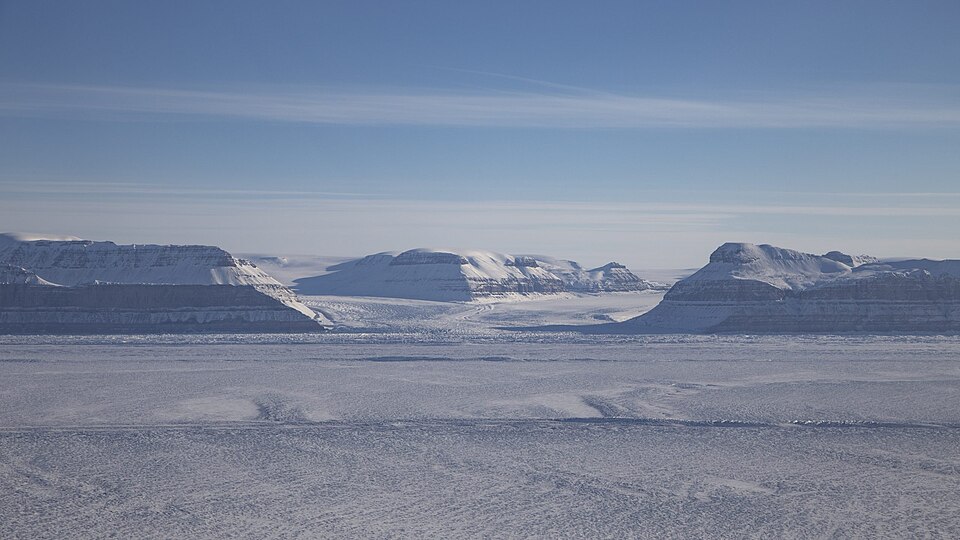
Cover image (depicts what the ice sheet may have looked like): Wikimedia Commons. (n.d.) The Greenland Ice Sheet. Available at (Accessed: 4 June 2026):
- Between and before the 5 ice ages, Earth was in greenhouse conditions for most of its history, an estimated 80–90% of geological time (about 4.5 billion years). Greenhouse state is the normal long-term state of the planet. We are currently in an Icehouse state. ↩︎
- Last Glacial Period (LGP) is the global term for the most recent glacial period, roughly 115,000–11,700 years ago. Because geologists in different regions developed their own names for glacial periods before a global framework existed, it is known as the Devensian glaciation in Ireland and Britain. ↩︎
- The Last Glacial Maximum (LGM) was the coldest phase of the Last Glacial Period (LGP), when ice sheets were at their greatest extent and global temperatures were at their lowest. ↩︎
- Mount Sandel, County Derry is the earliest known Mesolithic settlement site in Ireland, providing the earliest clear evidence of hunter-gatherer habitation in the country, dating to around 7900–7600 BC. ↩︎
- Carl Sagan (1934-1996) was an American astronomer, astrophysicist, cosmologist, and professor at Cornell University. He contributed to planetary science and NASA missions, including the Voyager programme. ↩︎
- The Magdalenian is an Upper Palaeolithic archaeological culture in Western and Central Europe, dating from about 17,000 to 12,000 years ago. It is named after the rock shelter of La Madeleine in the Dordogne region of France, where characteristic stone and bone tools were first identified. The culture is known for advanced bone and antler tools and Ice Age cave art. ↩︎
- When the Ice Age was ending and earth was warming up, a sudden disruption in ocean circulation caused a brief return to cold conditions. Thisi s called The Younger Dryas, before the climate warmed permanently into the Holocene. ↩︎
- Image: “Excavation of Alice and Gwendoline Cave” by Thorsten Kahlert, CC BY-SA 4.0 (via Wikimedia Commons). ↩︎
- An eolith (“dawn stone”) is a naturally fractured stone once thought, mainly in the late 19th and early 20th centuries, to be a very early human-made tool. The “eolith problem” refers to this misinterpretation, which later research showed was largely the result of natural processes such as glacial or river action rather than human manufacture. ↩︎

Leave a Reply